
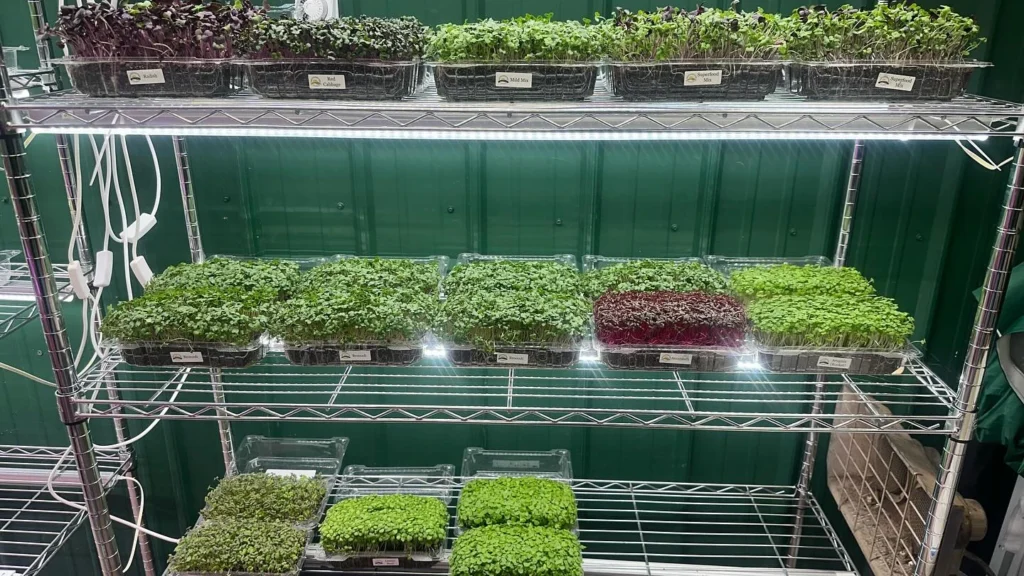
Think your home is too small to grow food? That assumption stops more people than space ever does. A few shelves, basic lighting, and smart planning are enough to turn a spare corner into a steady source of fresh microgreens.
This isn’t a hobby experiment or a trendy idea that fades fast. It’s a working system used by growers in apartments, basements, and spare rooms to produce nutrient-dense food and real income. Microgreens grow fast, sell quickly, and thrive in compact indoor environments.
They move effortlessly from home grow racks to restaurant plates. What looks simple on the surface is actually one of the most efficient forms of modern indoor farming. Let’s break down why it works—and why it works so well 🌱
Why Microgreens Make Sense
Microgreens stand out because they deliver speed, value, and efficiency all at once. Most varieties are ready to harvest in 7 to 14 days, which allows multiple crop cycles every month. That rapid turnaround means more output from the same square footage compared to traditional vegetables.
Nutritionally, microgreens punch far above their size. Research has shown many varieties contain significantly higher concentrations of vitamins, antioxidants, and minerals than their mature counterparts. That density is why chefs and health-focused buyers actively seek them out.
Flavor is another major driver. Red cabbage brings a sharp, peppery kick. Lemon sorrel adds a bright citrus note. Borage delivers a clean cucumber-like taste. These intense profiles make microgreens valuable not as garnish, but as ingredients.
From a business perspective, margins are strong. A single tray often costs around $6 to produce, including electricity and consumables. That same tray commonly sells for $30 locally and much higher in premium markets. Selling microgreens with roots intact allows chefs to cut fresh at service time, which improves shelf life, flavor, and perceived value.
Even crops considered difficult, like cilantro, become viable when grown with precise moisture control, organic coconut fiber, and clean water—no chemical fertilizers or pesticides required.
Fast growth, low inputs, and premium pricing combine to make microgreens one of the most accessible indoor crops for small spaces.
Space Optimization: How Vertical Growing Works
The foundation of microgreens farming is vertical efficiency. Instead of spreading outward like traditional agriculture, production stacks upward. Shelving systems allow growers to multiply output without increasing floor space.
One successful indoor farm operates entirely inside a room measuring roughly 150 square feet. Within that space, vertical racks support dozens of trays at different growth stages. With around 70 trays in weekly rotation, the room functions like a compact production facility rather than a hobby grow area.
Each rack level is designed to hold a single tray layer, but when stacked vertically, the cumulative output becomes substantial. Taller crops like peas are placed on higher shelves, while low-profile varieties such as radish and arugula occupy tighter spacing below.
Workflow matters just as much as layout. Trays move smoothly from seeding to growth to harvest without crossing paths or creating bottlenecks. In high-turnover setups, trays are replanted multiple times per week, keeping production continuous.
This “grow up, not out” approach allows a room the size of a walk-in closet to supply restaurants, CSA subscribers, or local markets consistently.
System Components That Make It Work
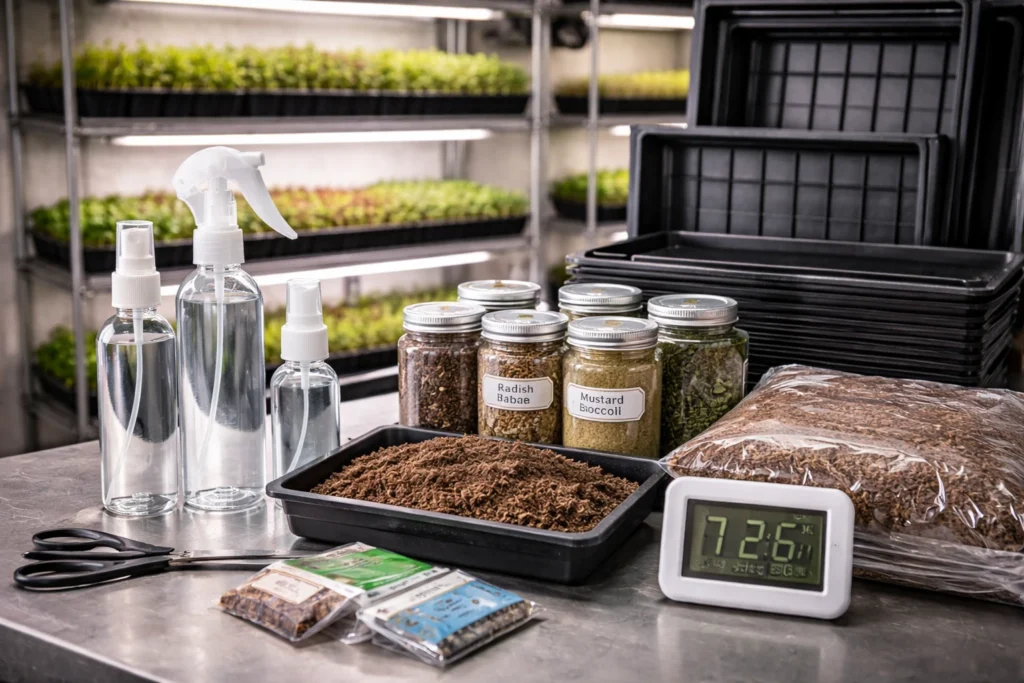
Successful microgreens systems rely on balance. Every component—light, water, air, and growing medium—must work together.
Lighting
Indoor farms depend on artificial light, and efficiency is critical. Low-voltage LED systems provide strong, even coverage without excess heat. This keeps humidity stable and prevents plant stress. Many growers use 18-hour light cycles to accelerate growth while keeping energy costs low. Even with dozens of trays in production, monthly electricity costs can remain surprisingly modest.
Growing Medium
Organic coconut coir is a preferred medium for microgreens. It holds moisture well, resists mold, and supports healthy root development. Because it’s inert and organic, it works perfectly in hydroponic-style setups where water delivers nutrients naturally present in the seed.
Water Use
One of the biggest advantages of microgreens farming is water efficiency. Some indoor farms use as little as five gallons of water per day to support 70 trays—roughly one cup per tray. Compared to soil farming, this represents massive water savings with almost no runoff or waste.
Environmental Control
Humidity, airflow, and cleanliness are non-negotiable. Enclosed grow areas sometimes require targeted ventilation to prevent condensation buildup. Airflow adjustments, simple vents, and spacing between trays help avoid mold and structural moisture issues.
Heat generated from lights and composting organic waste can even be reused to warm adjacent grow zones, creating a simple closed-loop energy benefit.
Crop Selection and Smart Rotation
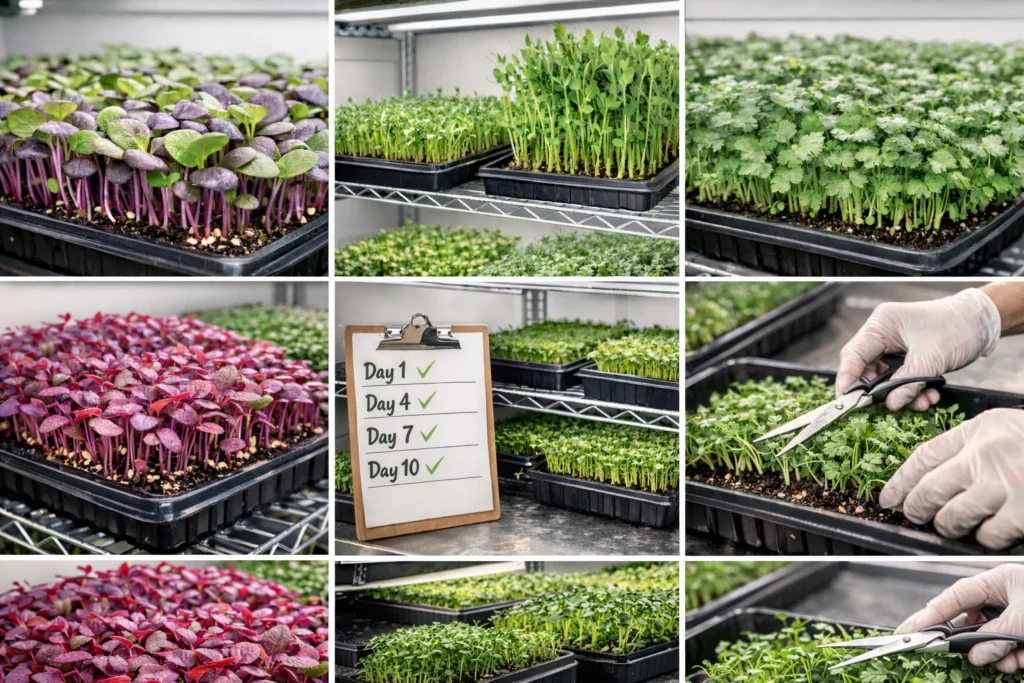
Crop choice is guided by three factors: demand, growth speed, and value per square foot. Radish, peas, cilantro, amaranth, and specialty greens consistently perform well in vertical systems.
Pea shoots are often grown in varying heights to fully utilize vertical space. Amaranth stands out for its color and resistance to common seedling issues. Cilantro rewards precision growers with high demand and premium pricing.
Rotation keeps the system profitable. Trays are planted, harvested, and replanted on staggered schedules so something is always ready. Most crops move from seed to sale within two weeks, which keeps cash flow steady and minimizes downtime.
Staggered planting also reduces disease pressure and balances energy use across growth stages.
Precision Environment, Minimal Waste
Indoor microgreens farming removes weather risk but replaces it with precision control. Humidity and airflow must be monitored closely. Even small adjustments—like adding ventilation openings or spacing trays—can prevent moisture-related issues.
Temperature stability is often achieved without dedicated heating systems by reusing waste heat from lights and composting processes. This keeps operating costs low while maintaining consistent growing conditions.
Lighting schedules are dialed in to support plant metabolism without excess heat. Combined with organic growing media and clean water, the result is a low-input system that still delivers high yields.
Harvesting, Packaging, and Delivery
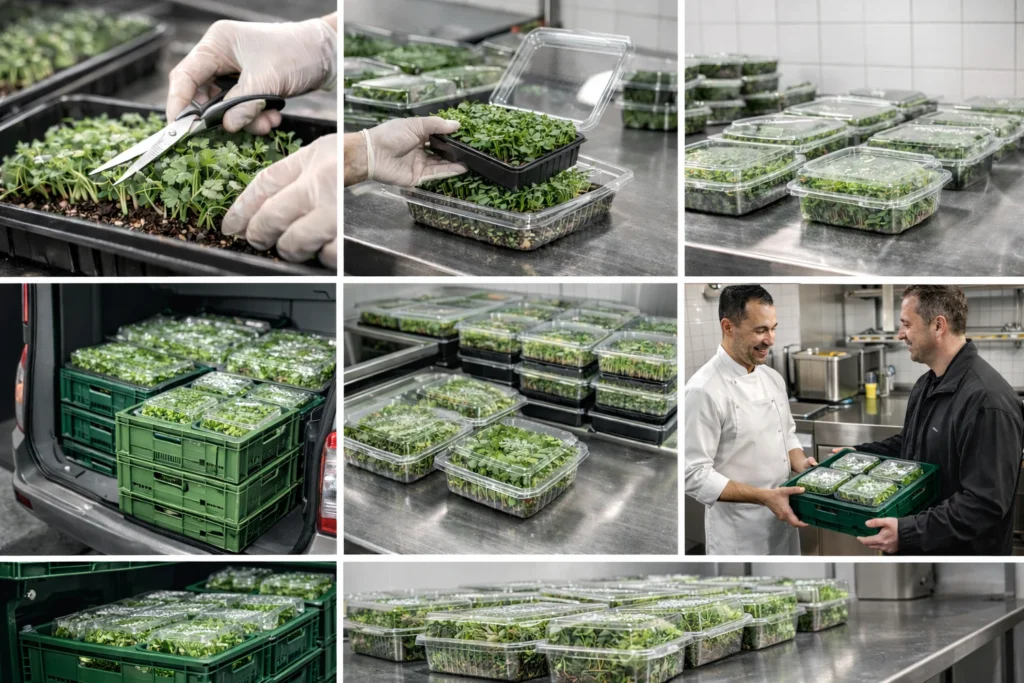
Microgreens are harvested frequently—sometimes daily. Most varieties reach peak quality between 7 and 12 days. Harvest timing is critical for flavor, texture, and shelf life.
Many growers sell microgreens live, with roots attached. This allows buyers to cut just before use, preserving freshness and nutrients. It also reduces waste compared to pre-cut greens.
Packaging happens in clean, designated areas to prevent contamination. Orders are often prepared the same day they’re delivered, following a just-in-time model that eliminates storage needs and reinforces freshness.
Local delivery keeps logistics simple and strengthens relationships with chefs and retailers.
Profitability and Real Market Demand
Microgreens vertical farming delivers strong returns in small spaces. A single 10-by-15-foot room producing 70 trays per week can generate over $2,000 weekly at modest pricing. Annual revenue can exceed $100,000 from one room when systems are optimized.
Operating costs stay low. Electricity bills often sit around $125 per month. Water use is minimal. Inputs are predictable and scalable.
The most successful growers focus on high-value buyers—chefs, specialty markets, and health-conscious consumers who understand the value of fresh, locally grown greens.
Some growers expand beyond production by selling systems, offering consulting, or teaching others how to replicate their setup. During market shifts, many also pivot successfully into home growing kits, proving the flexibility of the model.
Demand continues to grow alongside interest in plant-forward diets, functional nutrition, and local food systems. Microgreens aren’t a trend—they’re a practical solution for modern, small-space farming.