
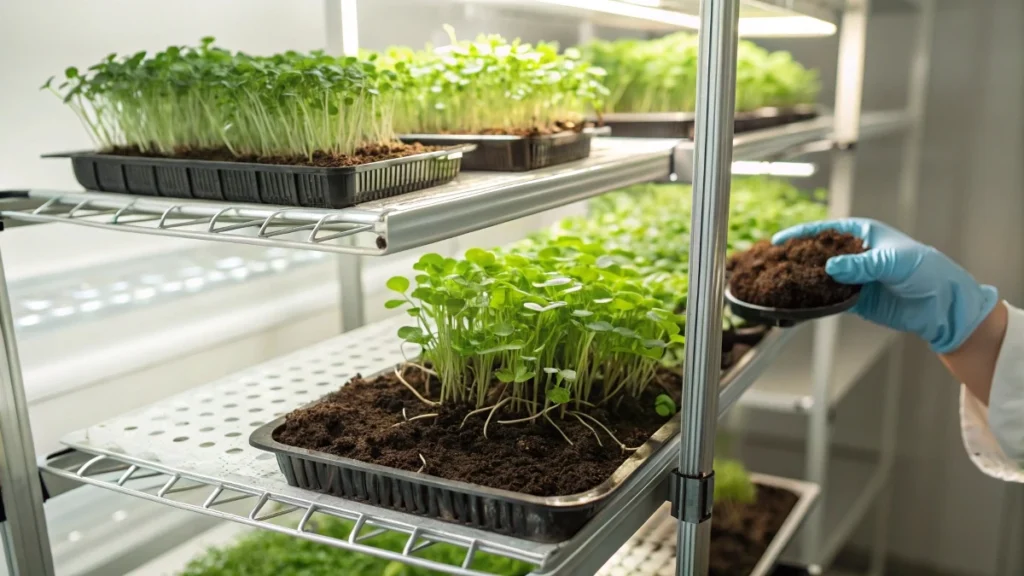
Choosing the best soil for indoor microgreens is less about “richness” and more about airflow, drainage, and a smooth surface that seeds can grip. Indoors, trays are dense, blackout stacking boosts humidity, and roots sit in a shallow zone. If the mix compacts or stays glossy wet, the crop slows, the canopy gets uneven, and shelf life drops.
USDA research describes microgreens as seedlings harvested about 7 to 14 days after germination, cut just above the growing surface. They can carry higher vitamin and carotenoid levels than mature leaves, which is why freshness and post harvest quality matter so much. (Agricultural Research Magazine)
What the growing medium must do indoors
A reliable microgreens mix does four jobs at once.
- Hold roots firmly so stems stand upright in dense mats
- Drain fast so the root zone stays oxygenated
- Stay evenly moist without turning soggy
- Provide light, steady nutrition, not a heavy compost load
A University of California agriculture guide recommends a clean potting medium or sterile seed starting mix, and it explicitly warns against using compost as the base medium because it can cause issues like off odors. (UC Agriculture and Natural Resources)
That aligns with what growers see in practice. When the medium is too fine or too wet, you do not just risk mold. You also lose yield because roots cannot breathe.
🌿 Recommended Microgreens Supplies |
Soil vs mats
Soil and soilless mixes are the most forgiving path for cut microgreens because they buffer moisture and offer a small nutrient reserve. Mats can be excellent for speed and cleanliness, especially for live tray sales, but most mats bring almost no nutrition on their own, so you must supply everything through water and stay consistent.
If your goal is thicker stands and better color without turning feeding into a daily chemistry project, soil-based mixes usually win.
The indoor traits that matter most
High porosity beats heavy mixes.
You want a mix that feels springy, not dense. High porosity means more air pockets, faster drainage, and fewer anaerobic zones under blackout and dense sowing. In a shallow tray, that structure matters more than a high compost percentage.
Smooth texture improves germination.
Big chunks and stringy fibers create bald spots. Screen or hand-pick chunky bits so the top is level and fine enough for seed contact.
Nutrition should be measured.
Microgreens do not need a “hot” soil. Too much compost or castings can push moisture retention and microbial activity in the wrong direction in a crowded tray. If you want to fortify, do it with precise rates, not heavy scoops.
Proven indoor soil recipes
Recipe 1: Reliable DIY Coco Mix
Use this when you want low cost, consistent drainage, and easy sourcing.
Step 1
Coco coir: about 70 to 75 percent by volume
Step 2
Perlite: about 20 to 25 percent by volume
Step 3
Fully finished compost: about 5 to 10 percent by volume, optional, and kept light
Notes
If you are seeing fuzzy patches or a sour smell, reduce compost and increase perlite. If edges dry too fast, slightly increase tray fill depth rather than making the mix heavier.
Recipe 2: Peat-based high porosity mix
Use this when you want maximum reliability and fast turnover with fewer moisture surprises.
Choose a high porosity peat and perlite style mix that is marketed for drainage and air space. Keep the surface screened and smooth, then focus on bottom watering and airflow.
Recipe 3: Fortified premium mix
Use this when you want a richer color and a stronger nutrition story.
Start with a breathable base, then add a balanced organic fertilizer at a measured rate. Your draft mentions Gaia Green 4 4 4 at roughly 30 to 40 grams per gallon of mix. That is a reasonable “measured, not heavy” approach as long as you monitor moisture and avoid turning the tray into a wet compost system.
Important framing note
Your specific nutrition jumps like “protein up 41 percent” and “iron up three times” are powerful, but I could not verify those exact figures from a public, citable study in the sources I pulled for this reply. If those numbers come from your own lab test or a report you can link to, keep them. If not, present them as “in one lab comparison shared by growers” or “in our testing” rather than as a universal guarantee.
The simple management rules that make any soil work better
Fill depth
Most crops do well with a shallow, even layer. Bigger seeds like peas and sunflowers benefit from a bit more cushion, but avoid overfilling because deeper wet zones dry more slowly.
Watering style
Bottom watering is your best friend once roots reach the tray base. It keeps foliage drier and reduces the constant wet canopy that encourages problems. (UC Agriculture and Natural Resources)
Airflow
Gentle horizontal airflow helps the surface dry predictably. It is not about blasting trays. It is about removing still pockets of humid air.
Clean cycles
Start clean every time. Wash trays, sanitize tools, and do not leave spent media sitting indoors. Microgreens are quick, which means microbes can be quick too.
How to talk about your yield data the right way
Your pea shoot tray weights and side-by-side comparisons are useful and believable as internal testing. Just label them correctly so you keep trust.
Use language like this.
“In one controlled tray test using the same seed density and schedule, a high porosity peat-based mix produced the highest pea shoot yield in our setup.”
Avoid language like this.
“This mix always yields 19 ounces.”
That small change protects you legally and keeps the article honest.
Quick troubleshooting by symptom
Soggy surface that stays shiny
Cause: mix too fine, too much peat, or too much irrigation volume
Fix: increase perlite or switch to a higher porosity base, and water smaller amounts more often
Patchy emergence
Cause: uneven surface, chunky media, uneven moisture under blackout
Fix: level and lightly firm the surface, screen chunks, press seed for contact, keep moisture even, not wet
Mold-looking fuzz
Cause: often a wet canopy or poor airflow, sometimes just root hairs
Fix: mist to check. Root hairs collapse when wet. True mold does not. Then increase airflow and switch to bottom watering fast.
Pale greens and thin stems
Cause: usually light too far away, sometimes low nutrition in an inert medium
Fix: bring lights closer and consider a small measured nutrient boost rather than adding more compost.
A science-backed nutrition note you can safely include
If you want one strong, defensible line about nutrient density, USDA ARS reporting on microgreens found they can contain considerably higher levels of vitamins and carotenoids than mature counterparts, and they note the harvest window is typically 7 to 14 days after germination. (Agricultural Research Magazine)
That supports the “why microgreens are worth doing well” angle without relying on numbers you cannot source.