
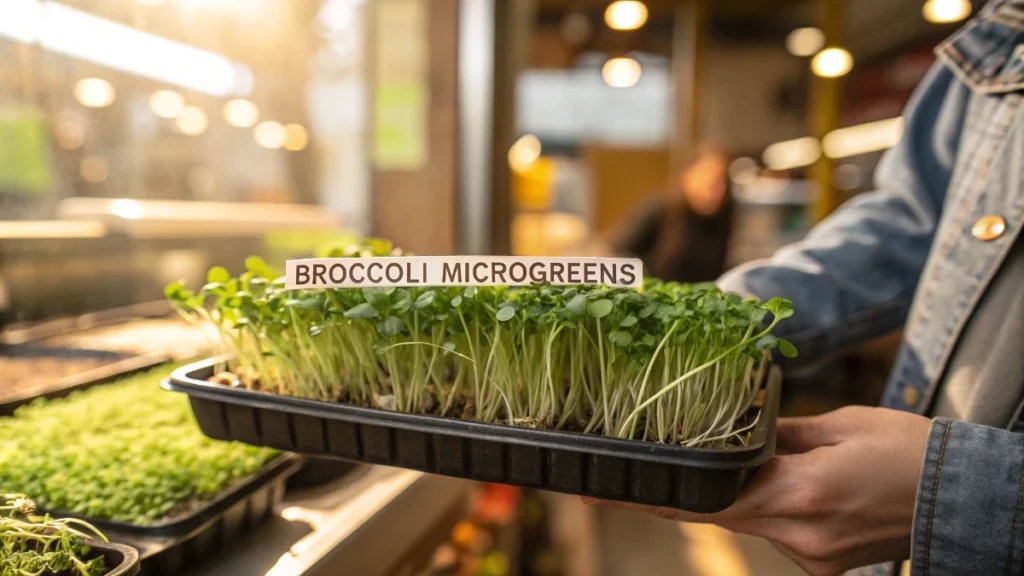
Microgreens look small, but they behave like a premium product for a reason. On the demand side, people pay for flavor, freshness, and the nutrient-dense reputation. On the production side, they grow fast, but they are not “easy.” A tray may finish in seven to ten days, yet those days are full of hands-on steps that repeat nonstop.
A typical cycle is busy from start to finish. Trays are seeded, stacked under weight, and kept in blackout. They get moved under lights at the right moment, watered with precision, and harvested in a narrow window. Some crops need hull removal. Many growers spin or air dry to hit the right moisture, then pack, label, chill, and deliver. After that, every tray, shelf, tool, and workspace gets washed and sanitized so the next round does not start with contamination. The crop is one and done, so costs reset constantly. Once you include cold storage, delivery time, compliance, and the fact that most growers sell locally rather than at an industrial scale, the price on the clamshell starts to make sense.
Why customers pay more for microgreens
They carry culinary status and a wellness halo.
Microgreens have been marketed for years as fresh, clean, and nutrient-dense. That story matters. When shoppers believe a food is special, they treat it like a specialty item rather than a commodity. The product also performs immediately. A small pinch changes flavor and plate presentation, so buyers feel the value right away.
The market already accepts premium pricing.
In many places, a small retail clamshell sells for around ten dollars. At farmers’ markets, a common pattern is a pack of one to two ounces priced near five dollars, with bundle deals to encourage volume, like five packs for twenty dollars. Those price points are not random. They reflect what shoppers repeatedly agree to pay in real life.
When you translate that back to tray value, the numbers add up fast. Heavier crops like pea shoots or sunflowers can turn one 10×20 tray into multiple packs, creating strong retail value for a direct seller. Lighter brassica mixes may produce less weight per tray, so their total tray value can land lower even when the per-pack price looks similar.
The category is positioned as “growing.”
You will often see industry summaries that frame microgreens as a fast-growing market category, with global projections rising through the next decade. These reports are directional, not a guarantee for any individual farm, but they reinforce a shared perception: microgreens are modern, desirable, and worth paying for. That perception itself supports higher shelf prices.
🌿 Recommended Microgreens Supplies |
The plant grows fast, but the labor is constant.
People assume the short crop cycle means low effort. It’s the opposite. Speed compresses the work. Microgreens behave more like a bakery than a field crop: the product is made on a schedule, and the schedule demands daily attention.
Where does the time really goes
For many growers, harvest and post-harvest take the biggest share of labor. Cutting, checking quality, removing hulls for certain crops, drying to the right moisture, packing, labeling, and moving product into cold storage can represent roughly half of total production time.
When you plan by the tray, a realistic benchmark in a careful operation is often twenty to thirty minutes of total hands-on time per tray across the cycle. That does not mean one person stands over a tray for thirty minutes straight. It means the tray “consumes” labor in short bursts every day, plus a heavier block on harvest day.
Why does that push the final price up
Even at modest hourly pay, labor adds up quickly across dozens or hundreds of trays. And microgreens do not give you a second cut. You harvest once, dump media, wash the tray, sanitize, and start over. No regrowth spreads cost across multiple harvests.
The unit economics look simple until you include the real costs
A microgreens tray is not expensive because the soil and seeds are inexpensive. It is expensive because the system around that tray must deliver consistent quality, food safety, and timing.
Useful value anchors
A standard 10×20 tray often holds retail value in the range of twenty to thirty dollars, depending on crop and sales channel. Wholesale can be lower, especially for staple items like sunflowers, because the buyer expects a margin too. Chef-focused varieties can command higher per-pound prices, but those markets are narrower, and volumes tend to be smaller.
Inputs are not huge, but upgrades add up.
Seed and growing medium can be relatively low per tray, yet packaging can shift costs noticeably. A simple bag is cheaper. A clear clamshell with a tight lid and a printed label costs more, but it improves shelf presence and can protect texture in refrigeration.
Sanitation supplies matter too. Seed treatment and surface sanitation are recurring costs. Many operations also upgrade over time from cheaper materials to better ones because quality issues are expensive. A mold flare-up can wipe out profit far faster than a better sanitizer or a better airflow setup costs.
Margins are not always as high as shoppers assume
A five-dollar pack looks pricey until you count what sits behind it: labor, cold storage, delivery time, packaging, spoilage risk, and replacements for lights, fans, and trays. Many growers end up running a volume model rather than chasing luxury margins. They price to survive and to pay for time, not to get rich on a garnish.
Food safety, hygiene, and liability are built into the price
Microgreens are often treated as sprouts adjacent in the minds of buyers, especially restaurants and grocers. That means customers expect proof of clean processes.
The overhead is routine, not optional.
To stay consistent and keep accounts, farms build habits around:
- clean seed sources and sanitation steps
- strict washing and sanitizing of trays and tools after every harvest
- cooler temperature control and product handling
- harvest logs and basic traceability
These steps do not grow plants, but they prevent mold, reduce losses, and protect business relationships. Skipping them is how an operation gets rejected orders or loses its reputation.
Scaling adds paperwork
As sellers grow, permits, registrations, and inspections become part of the picture, depending on location. Even when paperwork is straightforward, it adds fees, time, and ongoing admin work that must be covered by pricing.
Perishability and the cold chain cost real money.
Microgreens breathe fast. If moisture or temperature slips, quality drops quickly. The farms that keep customers are the ones whose greens still look and smell great days after delivery.
Perfect timing is the job.
To hit that “still fresh a week later” standard, growers need:
- harvest at the right maturity
- fast cooling
- correct moisture level in the pack
- stable refrigeration
- cold transport during delivery
That means equipment, ice packs, insulated totes, and disciplined handling.
Spoilage and rejection risk are part of the business
A tray that goes long, gets too warm, or gets packed slightly too wet can be rejected. The grower eats the loss. Many farms invest in extra cooling capacity and backups not because it’s fun, but because one rejected delivery can cost more than the upgrade.
Packaging and presentation are not decoration.
Packaging is part of shelf life and buyer confidence. A sturdy clamshell can protect the canopy. A clean label builds trust. But both add cost per unit.
Crops like sunflowers and peas can also carry hulls that customers do not want. Taking time to remove hulls and dry product correctly improves quality and storage life, yet every extra minute multiplies across the week’s harvest.
Distribution is part of production.
Local farms win because they deliver fresh produce. That also means they deliver often.
Many growers run deliveries two times per week. Route planning, loading cold product, managing ice packs, invoicing, and customer communication take real time. Multi-channel selling adds more complexity: different pack sizes, different pricing, different pickup windows, and more customer service. It reduces risk, but it increases work.
Equipment and utilities are lean, but not free.
Microgreens have a low barrier to entry, which is why people start in spare rooms, basements, and small racks. The moment you grow beyond hobby scale, costs shift into:
- more racks and lights
- fans and airflow
- replacement bulbs or LED bars
- dedicated refrigeration
- wash stations and sanitation setups
- Higher electric use for lighting and cooling
Vertical growing is efficient, but every shelf uses power, and cooling adds to the bill. These costs arrive weekly, while payments from buyers may lag. Cash flow planning becomes part of the price.
The simplest reason microgreens cost more
Microgreens are a fast crop with a slow truth: you cannot automate away most of the work at a small local scale. Every tray is a short project that demands attention from seed to delivery, and then the entire system has to be cleaned to start again. The product is premium because the process is premium.
That is why a small package can cost more than a full bag of salad greens. You are not only buying leaves. You are buying timing, labor, cold handling, cleanliness, and consistency compressed into a week.