
When you see a meal topped with tiny greens, it’s easy to assume they’re all the same. Microgreens and sprouts look similar at a glance. They’re both fresh, fast-growing, and often labeled as nutrient-rich. No surprise people keep asking the same question: Are microgreens healthier than sprouts?
A fair answer takes more than looks. These foods are grown differently, harvested at different stages, and eaten in different ways. That changes their nutrient profile, how they behave in your kitchen, and even their food safety risk. Once you understand the gap between them, picking what fits your plate and your lifestyle gets simple.
Quick verdict: Are microgreens healthier than sprouts?
If you want the practical short version, here it is.
For most people chasing vitamins, antioxidants, and nutrient density per bite, microgreens usually come out ahead. They’re grown in a shallow medium, allowed to develop their first true leaves, then harvested. Some research has found certain microgreens can deliver far higher concentrations of specific nutrients than the mature vegetable, sometimes reported as “up to forty times” depending on the variety and compound measured. That’s why a small handful can feel like a concentrated upgrade.
Sprouts still deserve real credit. They’re especially appreciated for natural enzyme activity, which many people associate with easier digestion, plus useful plant-based protein when you’re sprouting legumes like lentils or mung beans. They also bring vitamin C, some B vitamins, and fiber.
So in plain language: microgreens tend to win on nutrient concentration and antioxidants, while sprouts shine for digestion support, speed, and convenience. You don’t have to choose one forever. Most kitchens benefit from using both.
What are sprouts?
How sprouts grow
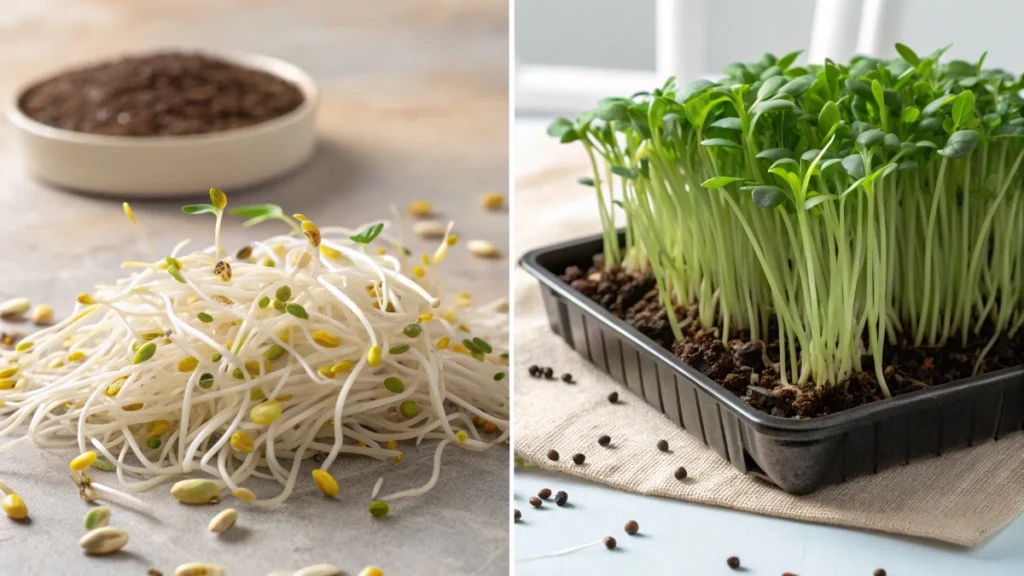
Sprouts are the earliest “awake” stage of a seed. You soak seeds like alfalfa, mung bean, or lentil, then keep them moist with regular rinsing. No soil. No growing medium. A jar or container with drainage and airflow does the job.
In roughly two to five days, the seed produces a small root and shoot. You eat the whole thing: the softened seed, the root, and the tender sprout. Because you’re eating the entire germinated seed, sprouts offer a different nutrient pattern than leafy greens.
Taste, texture, and everyday use
Sprouts are mild. Think fresh, slightly nutty or grassy, and rarely intense. Their texture is soft but crisp because they hold a lot of water.
That gentle flavor is why they work in everyday meals. Toss them into salads, layer them into wraps, pile them on sandwiches, or add them at the end of a stir fry for crunch. When you want something fresh now, sprouts are the fastest way to get it.
Key nutrients in sprouts
When a seed sprouts, it switches from storage mode to growth mode. Compounds inside the seed change form to feed the baby plant. For you, the main benefits people look for are:
Enzymes
Sprouts are well known for their enzyme activity because the seed uses enzymes to break down stored starches and proteins. Many people like sprouts because they feel lighter and easier to digest.
Protein
Legume sprouts can add a meaningful bump of plant protein for their size, which helps if you’re building more plant-forward meals.
Vitamins and fiber
Sprouts contribute vitamin C and some B vitamins. They also add fiber, especially since sprouts are easy to eat by the handful, not just as a garnish.
🌿 Recommended Microgreens Supplies |
What are microgreens?
How microgreens grow
Microgreens are the next stage after sprouting. Instead of harvesting immediately, you let the plant grow in a shallow tray with soil or another medium. Seeds are scattered densely, kept moist, and given light from a window or grow light.
Over about seven to twenty-one days, the plant develops its first true leaves. Then you harvest by snipping above the surface. You eat the stem and leaves, not the roots, and usually not the seed hull.
Popular types include kale, broccoli, radish, arugula, beet, and sunflower. Each variety has its own flavor, color, and nutritional strengths.
Taste, texture, and presentation
Microgreens feel more like tiny salad greens. They’re crisp, leafy, and their flavor is usually stronger than sprouts because the plant has had more time to develop natural oils and plant compounds.
Radish microgreens can be peppery. Sunflower tends to be nutty with a gentle sweetness. Kale is earthy and familiar, but softer than full-grown kale.
They also look great on a plate. Bright greens, reds, and purples can make simple food feel intentional. Restaurants use them as a finishing touch for a reason, and at home, they can do the same for soups, bowls, eggs, and toast.
Key nutrients in microgreens
Microgreens are loved for nutrient density. Some studies have reported that certain varieties contain much higher concentrations of specific vitamins and plant compounds than the mature vegetable. The “up to forty times” number gets repeated a lot, and while it won’t apply to every microgreen or every nutrient, it does reflect the big idea: this growth stage can be extremely concentrated.
Here’s what people often get from microgreens:
Vitamins
Wide varieties are rich in vitamin C, vitamin E, and vitamin K. Vitamin C supports immune function and tissue repair. Vitamin E helps protect cells. Vitamin K supports normal blood clotting and bone health.
Antioxidants and plant compounds
Microgreens provide phytonutrients like carotenoids and other antioxidant compounds that support the body’s defense against oxidative stress, which matters for long-term health.
Fiber with very low calories
They add bulk and fiber without adding many calories. That makes them useful if you’re trying to improve diet quality without eating massive portions.
Nutritional comparison: sprouts vs microgreens
People aren’t really asking which one “wins” in a lab. They’re asking what makes sense in real meals.
Vitamins and minerals
Microgreens usually have the edge in nutrient density per gram, especially for certain vitamins and antioxidant compounds. Because you’re often eating smaller amounts, concentration matters.
Sprouts still contribute vitamins, especially vitamin C and some B vitamins, but their measured concentration per gram is often lower. The catch is portion size: sprouts are easy to eat in bigger piles, so the daily total can still be meaningful.
Protein, fiber, and fullness
If plant protein is your priority, legume sprouts are practical. They add more protein per bite than leafy microgreens, and they’re easy to load into a bowl.
Both contain fiber. Sprouts can feel more filling simply because people eat more of them at once. Microgreens add fiber too, just usually in smaller quantities because they’re used like a topper.
Enzymes and digestion
Sprouts stand out here. The sprouting process activates enzymes, and many people value sprouts for how they feel after eating them, especially in heavier meals.
Microgreens support digestion mainly through fiber and the way they encourage more whole foods on your plate, but they don’t have the same enzyme reputation.
Antioxidants and long-term support
Microgreens generally have a stronger showing for concentrated antioxidant compounds. That’s one reason they’re often used as a “nutrient booster” even in small servings.
Sprouts also contain protective compounds, especially cruciferous sprouts like broccoli, but the spotlight for extreme concentration has mostly landed on microgreens.
Real portion reality
Microgreens are flavorful, so they’re often sprinkled. Sprouts are mild, so they’re often piled. Your habits matter more than a single chart.
A pinch of microgreens daily can still be powerful. A big handful of sprouts can add volume, fiber, and protein. The best choice depends on how you actually eat.
Food safety: an important difference
Both are usually eaten raw, which makes growing conditions important.
Why sprouts carry a higher contamination risk
Sprouts grow warm and wet. Seeds are soaked and kept moist with frequent rinsing. That environment is great for germination and also friendly to unwanted bacteria if anything is contaminated.
This doesn’t mean sprouts are “bad.” It means they demand better hygiene. Use clean jars, rinse with clean water, drain well, and buy seeds from reliable sources. If you notice a bad smell, slime, or odd discoloration, toss the batch.
People with higher risk immune situations, including pregnancy or compromised immunity, often choose to cook sprouts lightly or avoid them unless they trust the handling.
Why microgreens are typically lower risk
Microgreens grow with light and airflow in a tray. They’re not continuously soaking in water, and you harvest above the growing surface. That setup is generally less favorable for bacterial growth compared to jar sprouting.
You still need basic cleanliness: clean trays and tools, rinse before eating, and refrigerate promptly.
Growing at home: speed, cost, and setup
Sprouts: fast and minimal
Sprouts are the quickest. A jar, a lid or mesh, water, and a small amount of seeds are enough. Soak, rinse twice daily, drain well, and in a few days, you’re eating fresh sprouts.
They’re also budget-friendly because a small quantity of seed expands into a lot of food, and you eat the whole sprout with almost no waste.
Microgreens: a little more setup, more variety
Microgreens take longer but offer more flavor and visual appeal. You’ll need a tray, growing medium, seeds, and consistent light. Once you get the routine down, they’re still affordable, but the starting setup is bigger than sprouting.
Many people find the extra effort worth it because the harvest feels more like “real greens” and the flavors are stronger.
How they fit into meals
Best uses for sprouts
Sprouts blend in. They add crunch and freshness without hijacking flavor. Great for sandwiches, wraps, salads, noodle bowls, and last-minute toppings on warm dishes.
Best uses for microgreens
Microgreens act like a finishing ingredient. They add color and punch. Try them on eggs, soups, grain bowls, roasted vegetables, dips, and toast. Some varieties also work well in smoothies.
Using both together
They’re not rivals. A bowl can use sprouts for volume and protein, plus microgreens for flavor and vitamin density. The combination is often more satisfying than either one alone.
Which one fits your health goals?
For digestion and gut support, sprouts tend to be the better match due to enzyme activity and easy-to-eat fiber.
For maximum nutrient density in small servings, microgreens usually win thanks to concentrated vitamins and antioxidant compounds.
For busy schedules and tiny spaces: sprouts are easier and faster.
For flavor, color, and presentation: microgreens shine.
If you want the most balanced routine, use both. It’s the simplest way to cover more bases without turning meals into a project.
Myths worth ignoring
“Sprouts are unsafe.”
Sprouts do carry a higher risk if handled carelessly, but safe sprouting is doable with clean tools, clean water, proper drainage, and attention to freshness.
“Microgreens are too expensive.
Store-bought microgreens can be pricey, but homegrown trays are much cheaper per serving after the initial setup.
“You must pick one.”
You really don’t. They serve different purposes and work better together than alone.
Final verdict
Microgreens usually deliver more concentrated vitamins, antioxidants, and plant compounds per bite. Sprouts bring enzymes, plant-based protein, fiber, and fast convenience. Both can be low-cost, home-grown, and genuinely useful for a healthier routine.
A sprinkle of microgreens at breakfast, a handful of sprouts at lunch, and a mix at dinner is an easy rhythm that adds up over time. The real question isn’t which one is healthier in theory. It’s how you can use both to build a food routine you can actually stick with.